|
Population-specific diversity within fungi species could enable improved drug discovery |
Scientists at Oak Ridge National Laboratory and the University of Wisconsin–Madison have discovered that genetically distinct populations within the same species of fungi can produce unique mixes of secondary metabolites, which are organic compounds with applications in medicine, industry and agriculture. The finding could open new avenues for drug discovery and provide a deeper understanding of fungal evolution. |
|
|
Tiny but mighty precipitates toughen a structural alloy |
Scientists at the Department of Energy’s Oak Ridge National Laboratory and the University of Tennessee, Knoxville, have found a way to simultaneously increase the strength and ductility of an alloy by introducing tiny precipitates into its matrix and tuning their size and spacing. The precipitates are solids that separate from the metal mixture as the alloy cools. The results, published in the journal Nature, will open new avenues for advancing structural materials. |
|
|
Climate – Accelerating methane |
Scientists studying a unique whole-ecosystem warming experiment in the Minnesota peatlands found that microorganisms are increasing methane production faster than carbon dioxide production. These results could mean a future with more methane, a greenhouse gas that is up to 30 times more potent than carbon dioxide. |
|
|
Manufacturing – Powered by nature |
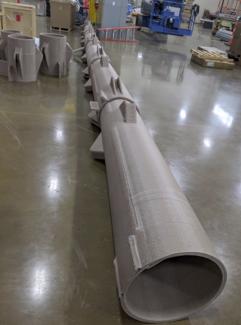
A team of researchers at Oak Ridge National Laboratory demonstrated the ability to additively manufacture power poles from bioderived and recycled materials, which could more quickly restore electricity after natural disasters. Using the Big Area Additive Manufacturing system, the team 3D printed a 55-foot pole designed as a closed cylindrical structure. They evaluated three different composite materials with glass fibers including cellulose ester, recycled polycarbonate and bamboo fiber reinforced polystyrene. |
|
|
Electric vehicles – Charged-up planning |
Researchers at Oak Ridge National Laboratory have developed a nationwide modeling tool to help infrastructure planners decide where and when to locate electric vehicle charging stations along interstate highways. The goal is to encourage the adoption of EVs for cross-country travel. |