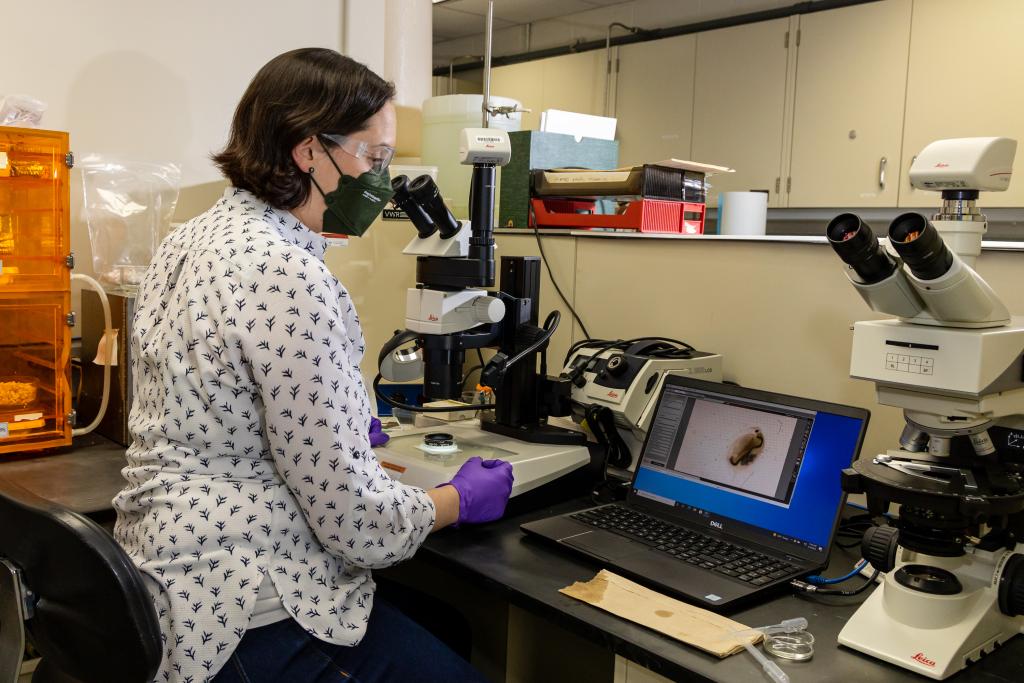
Stepping into the Aquatic Ecology Laboratory at the Department of Energy’s Oak Ridge National Laboratory, you can hear the sound of bubbling water. It’s the background music for Louise Stevenson as she moves about her day, exploring what aquatic species like fish, algae or tiny crustaceans can tell us about how contaminants may be affecting the nation’s water.
Stevenson is the principal investigator for the Environmental Toxicology Laboratory, which sits within the Aquatic Ecology Lab facility. In the Biodiversity and Ecosystem Health group at ORNL she uses her expertise as an environmental toxicologist to evaluate the effects of stressors such as chemicals and other contaminants on aquatic systems.
Projects in the "tox” lab, as Stevenson calls it, aim to characterize the impact of human-made stressors on natural systems. For aquatic systems, this includes water discharged from industrial, municipal and agricultural sources that flow directly into surface water.
To understand the effects of contaminants on an aquatic ecosystem, Stevenson uses regulatory testing and model organisms, which are well-studied organisms that allow her to make inferences at the population level. She works most often with Daphnia magna, small planktonic crustaceans related to lobsters and crabs. Also known as “water fleas,” Daphnia are found in ponds and other bodies of water. Daphnia are an essential component of Stevenson’s environmental research because they have short life cycles and are sensitive to the presence of toxins in the water, exhibiting measurable changes in their activities that act as a gauge for how other aquatic organisms might be affected.
“I consider Daphnia kind of the ‘canary in the coal mine’ of aquatic toxicity,” Stevenson said. “They are filter feeders, so they interact with a large volume of water and are also very sensitive organisms. They are widely studied, so we know a lot about how Daphnia respond to various abiotic and biotic stressors, which we can leverage into models of individuals and populations of Daphnia to predict impacts beyond the limits of our experimental design.”
Improving toxicity techniques
Stevenson is working to develop a framework that models and predicts how environmental stressors trigger changes across scales from individuals to populations and ecosystems. Her primary focus is on connecting changes in gene expression to an individual’s stress response, such as a fish making more of a particular enzyme in response to a toxin in the water. She is interested in applying findings about individual toxicity responses to the management of entire populations and ecosystems.
“We’re trying to mitigate ecological risks on these systems as a whole,” Stevenson said. “Extrapolating effects from individuals up to populations and communities can help scientists understand ecological risks at higher biological levels, where processes and interactions become more complex.”
Current best practices for environmental monitoring use standardized testing that minimizes variability on purpose. Stevenson is working on advancing environmental monitoring techniques to make them more efficient, effective and ecologically relevant. “While it’s important to do, these tests are so standardized that you’re going to get the same results with the same conditions every time in any lab,” Stevenson said. “Monitoring the environment is crucial in understanding the anthropogenic effect that chemicals and other existing and emerging contaminants have on the natural environment.”
Stevenson’s collaboration with scientists in other divisions at ORNL is an essential component of her work and demonstrates a core value at the laboratory: teamwork. “We’re working with material scientists who are developing novel lubricants for turbines deployed in aquatic systems,” she said. “As new lubricants are developed, we test the toxicity compared to those commercially available; this way the formulation can be refined.”
Stevenson is also studying the toxicity of per- and polyfluoroalkyl substances, or PFAS, synthetic chemicals widely used in consumer products to confer resistance to water, grease and oil. These long-lasting chemicals, frequently called forever chemicals, can be found in soil, air and water. Studies have shown they are linked to harmful health effects because of their persistence in the environment. With funding from the Department of Defense’s Strategic Environmental Research and Development Program, researchers at ORNL are investigating the toxicity of PFAS in aqueous firefighting foam.
Stevenson is also a strong advocate for women’s representation in science. She is the immediate past chair for Women in Science and Engineering, or WiSE, an ORNL employee resource group.