Topics: Supercomputing Clean Energy National Security
Every day, hundreds of thousands of commuters across the country travel from houses, apartments and other residential spaces to commercial buildings — from offices and schools to gyms and grocery stores. These destinations, combined with transportation between them, account for more than half of the total energy consumed in the United States each year.
To determine how these daily mobility patterns affect energy usage, researchers at the U.S. Department of Energy’s Oak Ridge National Laboratory partnered with the Smart City Division within the City of Chattanooga’s Department of Information Technology. Benefits from this work could ultimately include more efficient heating and cooling of buildings based on their populations and faster, better informed responses in emergency scenarios.
The team studied traffic data captured by 45 sensors stationed at major intersections in the busy downtown area of Chattanooga, a technologically advanced “smart city” in Tennessee that boasts a total of 100 traffic sensors and is home to multiple ORNL-led projects.
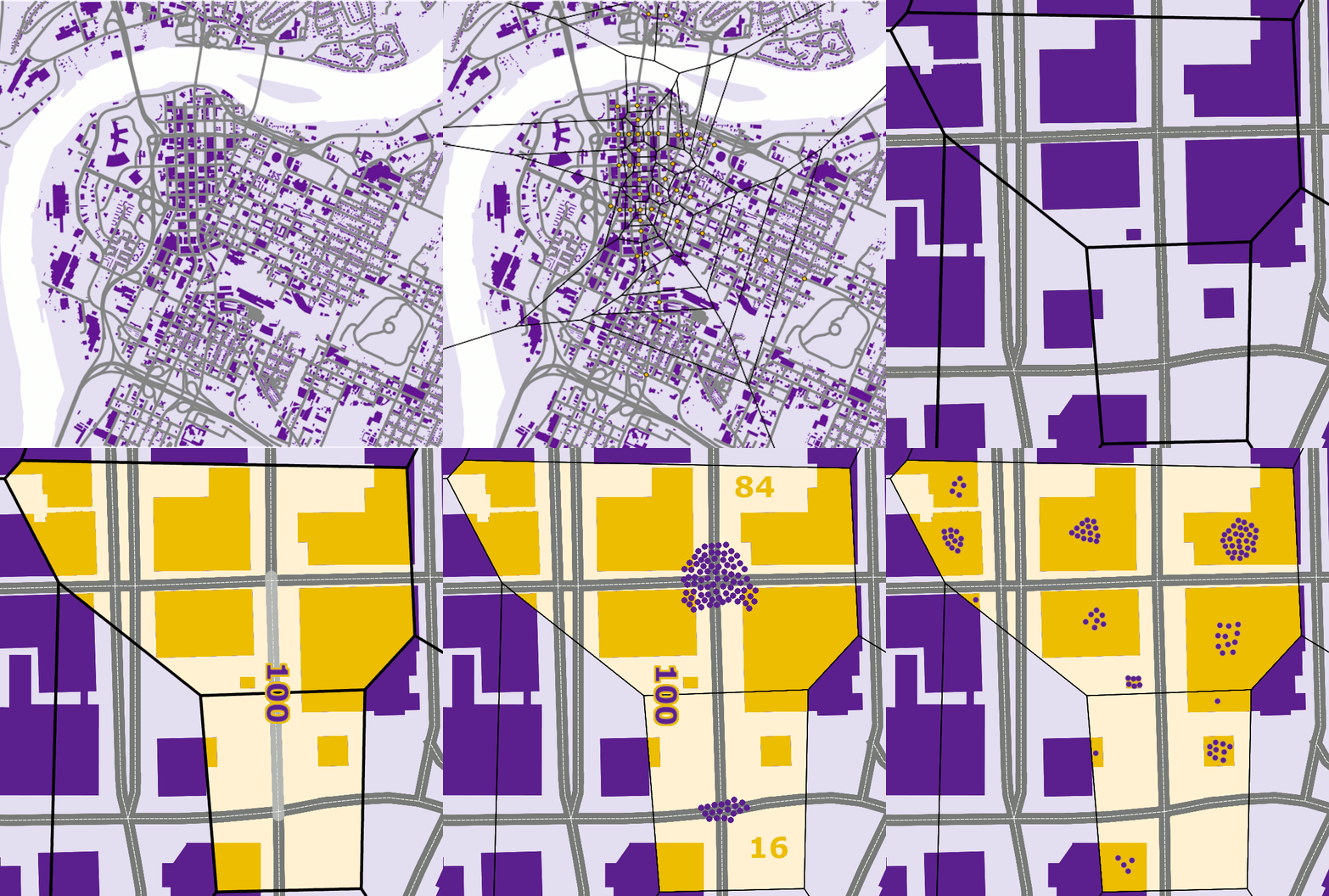
Although the sensors are designed to monitor traffic flow and reduce congestion by optimizing the timing of signal changes, the dense network was suitable, too, for the researchers to study the energy consumption of nearby buildings. They used Voronoi diagrams, which are computational geometry maps that assign buildings to one or more intersections within walking distance, to create occupancy schedules that estimate vehicle arrival and departure times. The schedules also approximate the number of people present in specific structures over the course of a year.
Led by ORNL researcher Andy Berres, the team focused on two adjacent sections, or “cells,” containing a finite number of intersections and buildings to obtain useful data while maintaining the privacy of individuals. The results are published in Building Simulation.
“There are a lot of aspects for which the number of people in a building makes a difference, and with these improved occupancy schedules, you can get a much more accurate picture of what’s actually happening energy wise,” Berres said.
Increases in building occupancy can lead to more demand for heating, ventilation and air conditioning; electricity; and other utilities, whereas decreases in occupancy may result in energy wasted on amenities in unoccupied areas. Although stock occupancy schedules can provide some insights into this balancing act, the team’s custom counterparts include more detailed data for individual buildings. The researchers anticipate that tracking monthly and seasonal trends in these schedules will reveal opportunities for enhanced efficiency.