In experiment after experiment, the synthetic radioisotope actinium-225 has shown promise for targeting and attacking certain types of cancer cells.
Although researchers have studied this radioisotope’s cancer-fighting potential for more than two decades, there’s not a Food and Drug Administration-approved treatment using Ac-225 — yet. But with multiple clinical trials now underway, it’s likely that both an approved treatment and increased demand for the radioisotope are in the near future — and the U.S. Department of Energy wants to be ready.
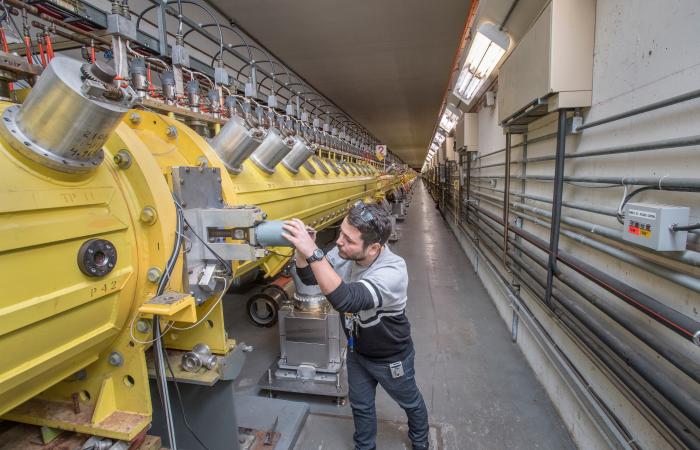
Since 2014, the DOE Isotope Program has sponsored the Tri-Lab research effort to provide accelerator-produced Ac-225 for radiotherapy. Thorium-232 targets are irradiated in proton accelerators at Los Alamos and Brookhaven national laboratories.
In experiment after experiment, the synthetic radioisotope actinium-225 has shown promise for targeting and attacking certain types of cancer cells.
Although researchers have studied this radioisotope’s cancer-fighting potential for more than two decades, there’s not a Food and Drug Administration-approved treatment using Ac-225 — yet. But with multiple clinical trials now underway, it’s likely that both an approved treatment and increased demand for the radioisotope are in the near future — and the U.S. Department of Energy wants to be ready.
Since 2014, the DOE Isotope Program has sponsored the Tri-Lab research effort to provide accelerator-produced Ac-225 for radiotherapy. Thorium-232 targets are irradiated in proton accelerators at Los Alamos and Brookhaven national laboratories.
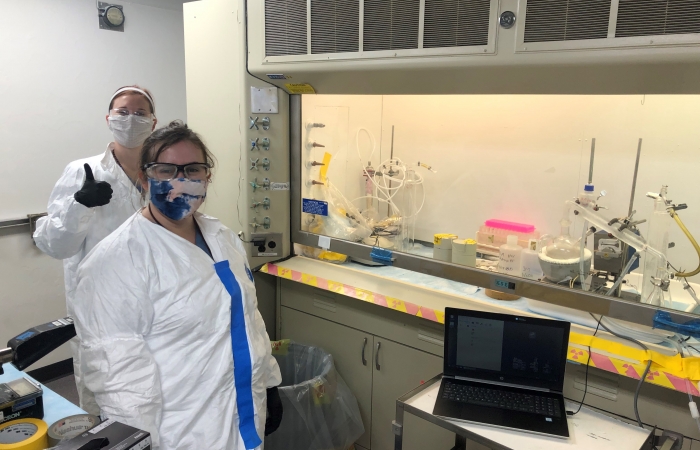
The purpose for all this collaboration is to produce large batches more quickly and more frequently. And in June, from the Tri-Lab effort, ORNL processed the largest batch of Ac-225 ever put into inventory.
The limited supply of Ac-225, a radioisotope that doesn’t occur in nature, is a major barrier to harnessing its promise for targeted alpha therapy cancer treatment. Researchers have found the high energy the radioisotope emits can attack cancer cells, destroying their ability to replicate and sometimes killing them altogether. To keep them from destroying healthy tissue as well, researchers attach alpha emitters — such as Ac-225 — to an antibody or protein with a receptor that can lock onto cancer cells. Alpha particles emit radiation for very short distances, so the treatment can be designed to leave surrounding cells unharmed. Ac-225 is ideal because of its 10-day half-life, the time it takes to decay to 50% of its original amount, which both gives it adequate time to reach the right cells and prevents it from accumulating in large amounts in the body.
ORNL presently produces the majority of the world’s Ac-225 by harvesting it from a supply of thorium-229 that slowly decays to Ac-225. But the amount of Ac-225 currently “milked” from the thorium-229 “cow”— about 1 curie annually — is not enough even for large-scale clinical trials, let alone widespread use for treating cancers. Increasing the amount of Ac-225 derived from the thorium cow is so difficult that it’s not a viable option for scaling up production.
That’s why so much is riding on the Tri-Lab effort, which can produce large batches more frequently. June’s record-setting demonstration batch was processed from targets irradiated at Brookhaven, which produces Ac-225 using a high-energy proton beam.